Example 6 — Alleluia. Pascha nostrum
The Alleluia of Easter Day. The same form as the Christmas one, but a wholly different brilliance : the ideal occasion to compare two jubili and hear what the mode changes in a melody.
- Genre
- Alleluia (acclamation before the Gospel)
- Occasion
- Mass of Easter Day, and throughout Eastertide
- Text
- 1st letter to the Corinthians (1 Cor 5, 7)
- Mode
- Mode VII (sol mode, bright and soaring)
- Style
- Melismatic : a brief verse, an ample vocalise
- In the Triplex
- p. 197
Listen first to the Christmas Alleluia, then to this one : mode II gathers itself in, mode VII soars.
The text and its translation
The mode is the « family of notes » in which a melody moves : its resting note, its favoured degrees, its colour. Chant has eight of them. Two chants of the same form and the same length can thus produce opposite impressions : that is exactly what happens between the mode II of Christmas, grave and inward, and the Easter mode VII, luminous and rising.
Two Alleluias, the same mechanism
Go back to the previous page and set the two chants side by side : you will see the same architecture. The word Alleluia, its jubilus, a verse entrusted to the soloist, then the return of the jubilus. What Eastertide adds is breadth : the vocalise stretches further, as if the joy of Easter needed more air.
A comparison exercise
- Count the neumes of the jubilus in both chants : the difference can be seen before it is heard.
- Look for the resting note (the one the melody falls back to) : re for Christmas, sol for Easter.
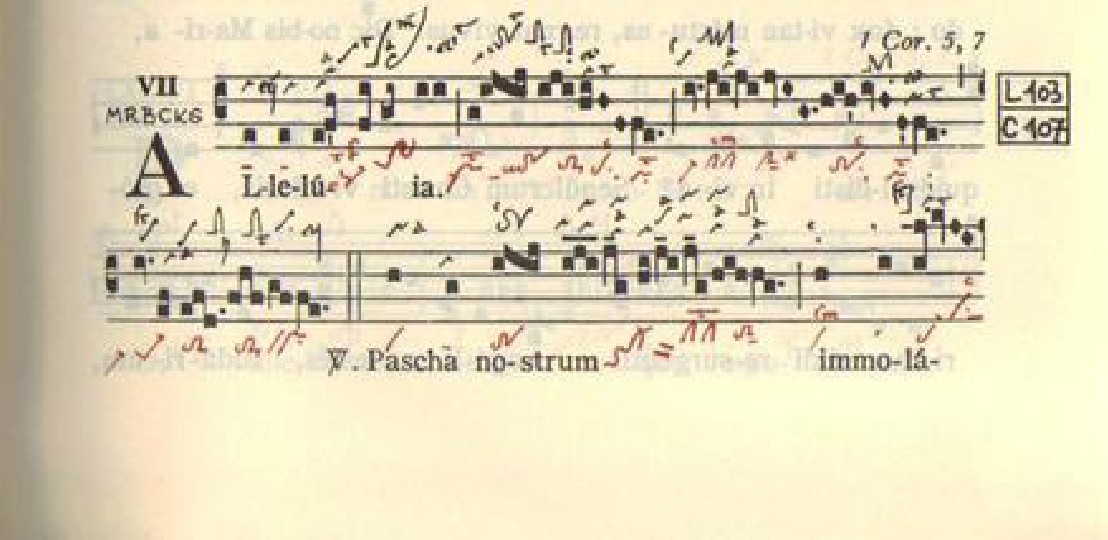
- Spot the quilismas : in the Easter ascents they are numerous — the voice gathers momentum.
Now is the moment to check something amusing : across two different jubili, the significative letters come back at the same strategic places — just before an ascent, at the top of a curve, right at the end. Laon (above) and St. Gall (below) do not decorate : they articulate.
Seeing the three notations
With these two Alleluias you have been round all the styles : syllabic, neumatic, melismatic, and the responsorial form that sets them in dialogue. All that remains is to keep the vocabulary at hand : on to the glossary.