Example 5 — Alleluia. Dies sanctificatus
The acclamation that precedes the Gospel on Christmas Day. A chant built on a single word — Alleluia — and on the long vocalise that prolongs it : the jubilus.
- Genre
- Alleluia (acclamation before the Gospel)
- Occasion
- Mass of Christmas Day (in die), 25 December
- Text
- Proper verse for Christmas : Dies sanctificatus illuxit nobis…
- Mode
- Mode II (low re mode, recollected)
- Style
- Melismatic : the word is short, the vocalise long
- In the Triplex
- p. 49
Watch for the return of the jubilus : it opens the chant, then comes back after the verse.
The text and its translation
venite gentes, et adorate Dominum :
come, you nations, and adore the Lord ;
The jubilus is the long vocalise that prolongs the final « a » of Alleluia. Saint Augustine gives it its finest definition : the song of a heart too full to find its words. It is the melisma in its pure state — the notes no longer carry a text, but a joy.
How an Alleluia is built
An Alleluia is not a chant « in a straight line » : it is a there-and-back. The soloist launches the word Alleluia, the choir takes it up and prolongs it with the jubilus ; the soloist then sings the verse ; then everyone returns to the starting point, jubilus included. This responsorial form — a soloist, a response — is exactly the one we met in the heritage of psalmody.
What that changes for reading
- The text is tiny (one word, then a short verse) : all the attention goes to the drawing of the neumes, not to the syllables.
- The jubilus is read like any melisma : you cut it up into familiar neumes — pes, clivis, climacus, quilisma.
- The return of the jubilus after the verse offers a rare opportunity : comparing the same line of neumes twice, a few centimetres apart.
In such a long vocalise, square notation gives the notes but not the breath. It is the layers of Laon (above) and St. Gall (below) that cut the jubilus into breathable little units : a c (celeriter) to flow on, a t (tenete) or an episema to settle. Without them, the jubilus is sung flat.
Alleluia melodies travel : one and the same melodic line often serves several verses through the liturgical year. The Alleluia repertoire is thus a wonderful field for observing the reuse of melodies — a common procedure in chant, where a known model is adapted to a new text.
Seeing the three notations
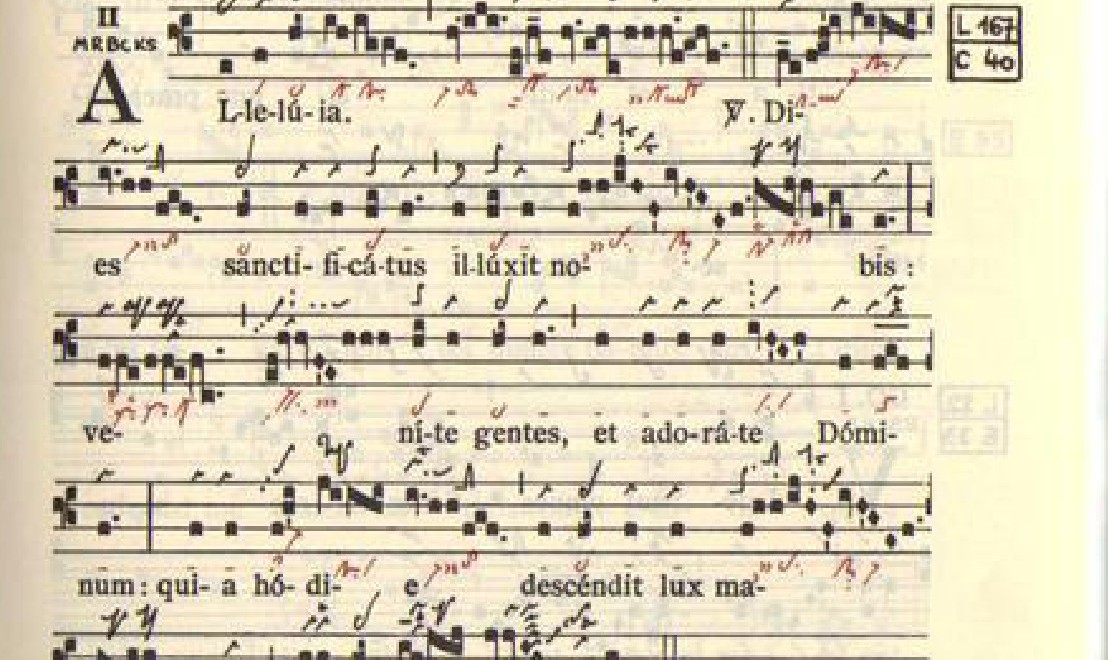
The Alleluia is the form in which the melisma becomes the subject : one word, an explosion of notes, a verse, and off we go again. Now listen to the same genre at the other great pole of the liturgical year : Easter.