Example 2 — Viderunt omnes
A gradual for Christmas Day, and one of the summits of Gregorian art : here a single syllable can carry dozens of notes. Welcome to the world of the melisma.
- Genre
- Gradual (meditative chant, after the 1st reading)
- Occasion
- Mass of Christmas Day
- Text
- Psalm 97 (98), verses 3 and 4, then verse 2
- Mode
- Mode V (fa mode, solemn and radiant)
- Style
- Melismatic : long garlands of notes per syllable
- In the Triplex
- p. 48
Listen to how a single syllable stretches into a long vocalise, depending on the performer.
The text and its translation
salutare Dei nostri :
the salvation of our God ;
ante conspectum gentium revelavit justitiam suam.
in the sight of the nations he has revealed his justice.
A melisma is a group of many notes sung on a single syllable (sometimes twenty, thirty notes or more !). It is the opposite of « syllabic » chant (one note per syllable). The melisma is the voice rejoicing, drawing out a vowel as one draws out a joy.
Why so many notes ?
A gradual is not made to be understood « word by word » like a reading : it is a chant of contemplation, entrusted to a soloist or a small, highly trained group. On key syllables — for instance the last one of om-nes or of ter-ræ — the melody blossoms into long vocalises. So do not try to « read fast » : here, one savours.
How to read a long melisma without getting lost
Faced with a garland of notes, the key is to cut it up into familiar little neumes. A melisma is never more than a sequence of bricks you already know :
- climacus figures (a note then a descending cascade of diamonds) — very frequent in descents ;
- linked pes and clivis figures, which make the line undulate ;
- sometimes a quilisma, that zigzag note which serves as a springboard in the middle of an ascent.
In such a dense melisma, the square notation in the middle shows clearly which notes follow one another. But it is above all the layers of Laon and St. Gall that rescue the performer : they show where to speed up (letter c, celeriter), where to settle (letter t, tenete, or an episema), so that the vocalise breathes instead of turning into a mush of notes.
The great melisma of joy is sometimes called the jubilus, typically the one that blossoms on the final « a » of Alleluia. Saint Augustine described it as the song of a heart too full to find its words. Viderunt omnes belongs to that same family of exuberant writing.
Seeing the three notations
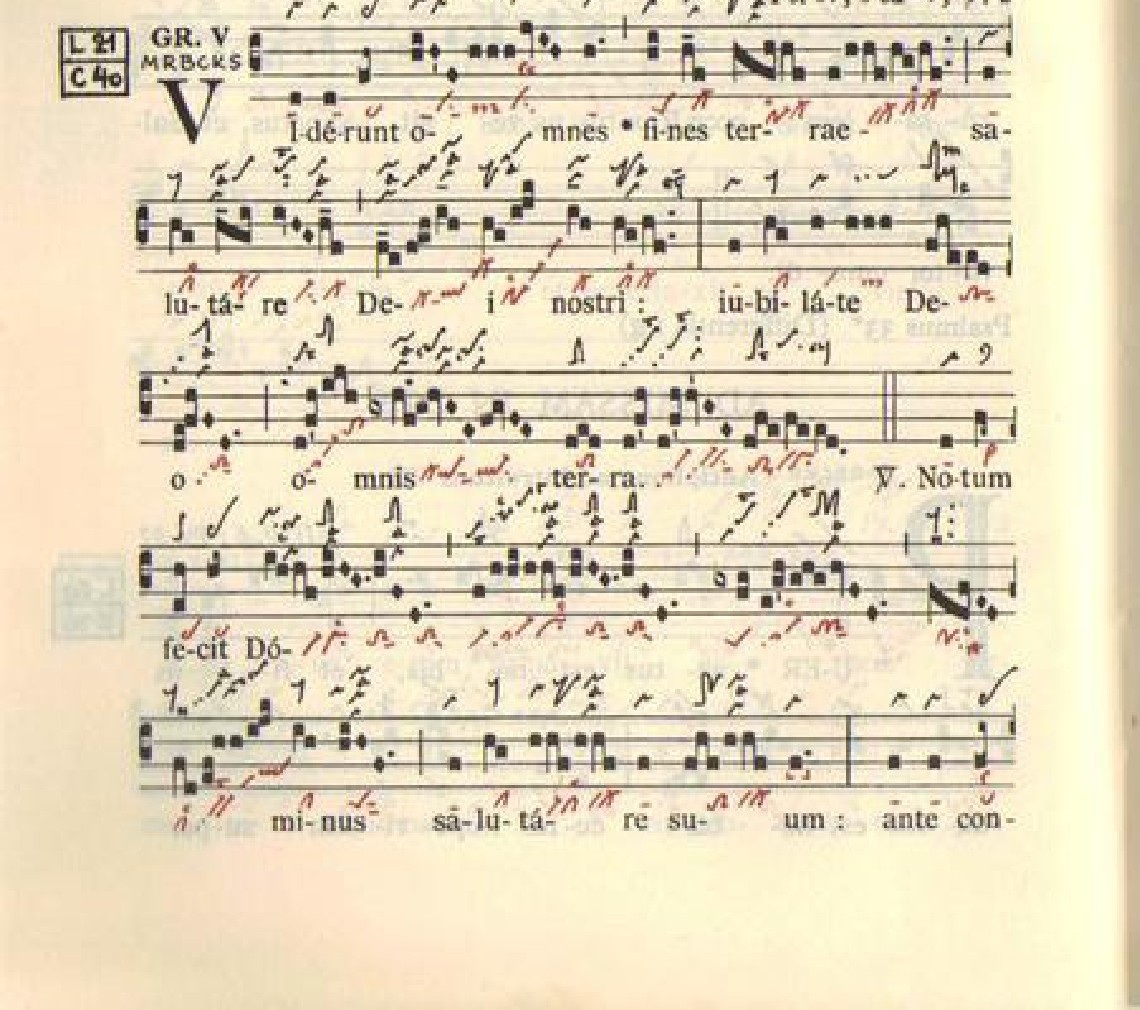
Viderunt omnes illustrates the melismatic style. The right reflex : cut up the long vocalises into familiar neumes, and rely on the significative letters for the rhythm. After this feast of notes, let us return to a more intimate chant : the dawn of Christmas.