The basics : learning to see a neume
Before opening the Graduale Triplex, let us set up a few simple landmarks. By the end of this page you will recognise the Gregorian staff, its clef, and about a dozen fundamental neumes.
1. The four-line staff
Our modern staff has five lines. Gregorian chant, by contrast, is written on a staff of only four lines (the tetragram). That is enough, because Gregorian melodies move within a fairly narrow range. As today, the higher a sign sits on the staff, the higher the sound ; the lower it sits, the lower the sound. One peculiarity worth knowing : the clef can sit on different lines — it is not fixed once and for all as in modern music, and it sometimes even changes in the middle of a piece.
A clef is a marker placed at the start of a line that names one of
the lines. In chant, two clefs are mainly used : the
C clef (do)  and the F clef
  .
They do not fix an absolute pitch
(the choir adjusts the pitch to its voices), but they show where the semitones fall,
which is enough to sing in tune.
.
They do not fix an absolute pitch
(the choir adjusts the pitch to its voices), but they show where the semitones fall,
which is enough to sing in tune.
2. The basic note : the punctum
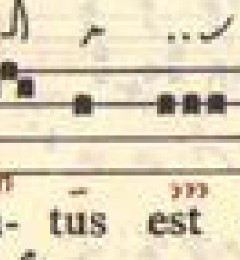
In square notation the commonest single note is the punctum — literally a « dot », drawn as a small square. A variant, the virga (« rod »), is a square extended by a small stem ; it often notes a higher note. When reading, punctum and virga are both worth a single note.
 Square notation
 Modern transcription
Punctum
1 note — "na-tus", p. 47
Modern transcription
Punctum
1 note — "na-tus", p. 47
 Square notation
 Modern transcription
Virga
1 note (often high) — "Al-le-luia", p. 199
Modern transcription
Virga
1 note (often high) — "Al-le-luia", p. 199
3. Two-note neumes
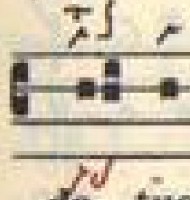
Things get more complex — and more interesting — when several sounds are sung on a single syllable. They are then grouped into a single drawing. The golden rule for reading : a neume is read from bottom to top and from left to right, following the stroke.
 Square notation
 Modern transcription
Pes (podatus)
2 notes going up — "da-tus", p. 47
Modern transcription
Pes (podatus)
2 notes going up — "da-tus", p. 47
 Square notation
 Modern transcription
Clivis (flexa)
2 notes going down — "fi-li-us", p. 47
Modern transcription
Clivis (flexa)
2 notes going down — "fi-li-us", p. 47
4. Three-note neumes
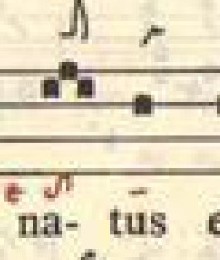
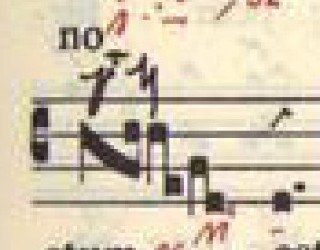
With three notes you draw small « waves ». Remember these four above all — you will meet them constantly :
 Square notation
 Modern transcription
Torculus
low · high · low — "na-tus", p. 47
Modern transcription
Torculus
low · high · low — "na-tus", p. 47
 Square notation
 Modern transcription
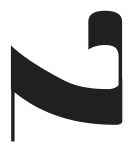
Porrectus
high · low · high, one curved stroke — "no-bis", p. 44
Modern transcription
Porrectus
high · low · high, one curved stroke — "no-bis", p. 44
 Square notation
 Modern transcription
Scandicus
notes going up — "ho-die", p. 49
Modern transcription
Scandicus
notes going up — "ho-die", p. 49
 Square notation
 Modern transcription
Climacus
1 note then a descent — "e-rit", p. 45
Modern transcription
Climacus
1 note then a descent — "e-rit", p. 45
5. Two signs that change the colour of the chant
Some small signs do not change the note, but the way it is sung. Here are two essential ones, which we shall meet again in the examples :
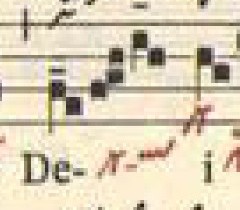
- The quilisma — a note drawn as a zigzag, light and fleeting, which acts as a springboard to the next note ; traditionally the preceding note is slightly lengthened.
- The episema — a small horizontal stroke added above (or beside) a neume to indicate that the note is settled on, broadened. It is the equivalent of a slight « leaning » of the voice.
 Square notation
 Modern transcription
Quilisma
light note, springboard — "De-i", p. 48
Square notation
Episema
settle / broaden — "De-i", p. 48
Modern transcription
Quilisma
light note, springboard — "De-i", p. 48
Square notation
Episema
settle / broaden — "De-i", p. 48
A neume = a drawing read from left to right and from bottom to top. Its shape tells the movement of the voice ; a few added signs (episema, quilisma) tell the manner. You now have all the basic vocabulary needed to tackle the book that brings them together.