The Graduale Triplex : three scripts for a single chant
Why three stacked notations ? Because none of them says everything on its own. Together they give both the right note and the soul of the chant.
When the monks of Solesmes published the Graduale Triplex in 1979, they were answering an old problem. The oldest chant manuscripts (9th–11th century) are of extraordinary musical subtlety : they notate the nuances, the leanings, the impulses of the voice. But they have one major flaw : they do not give the exact pitches. Conversely, modern square notation gives precise pitches… but has lost much of those nuances. The solution ? Superimpose the two worlds.
A notation is diastematic when the height of the signs precisely indicates the pitch of the sounds (as on a staff). It is adiastematic (or « in campo aperto », in the open field) when the signs float above the text : they show the melodic gesture without fixing the intervals. The old neumes are adiastematic ; square notation is diastematic.
The three « storeys » of the page
On a line of the Graduale Triplex, for each syllable of the text, you will find three pieces of information aligned vertically :
In the middle : the square notation (the Editio Vaticana)
This is the reference layer for pitch. On its four-line staff, with its clef, it tells you exactly which note to sing. It is the one we learned in The basics. If you were to read only one layer to « get out » the melody, it would be this one.
Above : the neumes of Laon
They come from a 9th-century manuscript kept at Laon (the « manuscript 239 ») and are printed in black. This family of writing, called Messine, is famous for its rhythmic precision : it distinguishes short from long notes very finely, notably thanks to added letters (see below).
Below : the neumes of St. Gall
They come from manuscripts of the abbey of St. Gall (in present-day Switzerland), such as the Cantatorium (manuscript 359) or the Einsiedeln 121 manuscript, and are printed in red. This script is admired for the clarity with which it draws the gesture of the melody and its articulation, likewise enriched with small letters.
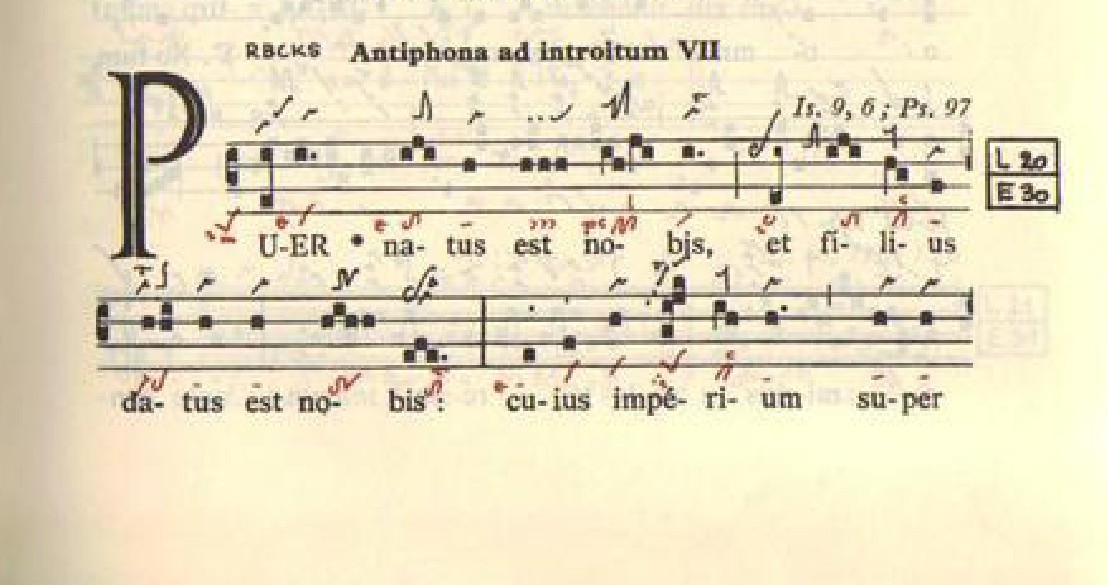
The « significative letters »
A delightful detail : the old copyists added small letters beside the neumes to specify the intention — rather like our markings « softly », « hold back » above a score. They are called litterae significativae. Here are some of the most frequent :
| Letter | Latin word | Meaning for the singer |
|---|---|---|
| c | celeriter | quickly, without dragging |
| t | tenete | hold, lengthen the note |
| a | altius | higher (go well up) |
| i / iu | iusum / inferius | lower |
| l | levare | lifting, lightening |
| m | mediocriter | moderately (neither too much nor too little) |
| e | equaliter | at the same pitch |
There is no need to decode everything at once ! The comfortable method : first read the note in the square layer in the middle, then look above and below and ask yourself « should I press on, settle, lighten ? ». The two old layers often confirm each other — and when they diverge, that is precisely where the chant becomes fascinating to interpret.
Triplex = 3 layers. The centre (square notation) gives the notes ; Laon (on top) and St. Gall (below) give rhythm and expression. We shall now see all of that come alive in six concrete chants.