Example 3 — Lux fulgebit
The entrance chant of the dawn Mass at Christmas. A chant of half-light, all delicacy : the perfect occasion to hear the nuances of duration.
- Genre
- Introit (entrance chant)
- Occasion
- Mass at dawn on Christmas Day (in aurora), in the early morning of 25 December
- Text
- After Isaiah (Is 9, 2 and 9, 6) and psalm 92
- Mode
- Mode VIII (sol mode, peaceful and settled)
- Style
- Neumatic and measured : ideal for observing durations
- In the Triplex
- p. 44
As you listen, spot the settled notes and the flowing ones.
The text and its translation
Princeps pacis, Pater futuri sæculi :
Prince of peace, Father of the world to come ;
The real subject here : the duration of the notes
So far we have asked « how many notes ? » and « do they go up or down ? ». Lux fulgebit invites us to a subtler question : « how long does each note last ? ». For in chant, not all notes have the same duration : some are light and fleeting, others settle and broaden.
Chant alternates short notes (the ordinary, light flow) and lengthened notes, on which the voice lingers for a moment. This is not a « square » rhythm like a military march : it is a supple breathing, guided by the meaning of the text.
Where do you read these durations ?
This is precisely the area where the old notations of the Triplex shine :
- The episema (small stroke) above a St. Gall neume : « settle, broaden ».
- The letter t (tenete) : « hold the note ».
- The letter c (celeriter) : on the contrary, « pass quickly, do not lean ».
- In the notation of Laon, the very shape of the stroke (rounded, « hooked »…) already distinguishes short from long with remarkable precision.
On the word Lux (the « light ») and then on fulgebit (« will shine »), ask yourself : does the upper layer (Laon) or the lower one (St. Gall) tell me to settle the voice, or to flow on ? You will find that the moments of leaning often fall on the words the text wants to highlight : the light, the birth, the peace.
Seeing the three notations
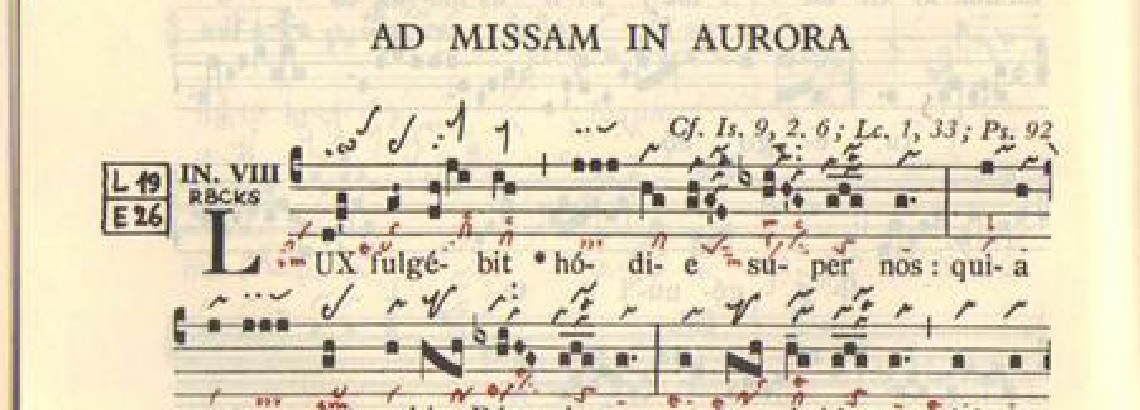
With Lux fulgebit we move from the question « which notes ? » to the question « what duration, what leaning ? ». This is the heart of what makes the Graduale Triplex so precious : the two old layers make audible what square notation alone leaves mute.