Example 4 — Victimæ paschali laudes
The great Easter sequence. With it we change period and style : a later chant, closer to the text, and even built like a little dialogue.
- Genre
- Sequence (sequentia), sung before the Gospel
- Occasion
- Easter Day (and its octave)
- Author
- Attributed to Wipo of Burgundy (11th century)
- Mode
- Mode I (re mode, at once grave and luminous)
- Style
- Rather syllabic : often one note per syllable
- In the Triplex
- p. 198
Follow the dialogue « Dic nobis Maria… » by ear : question, then answer.
The text and its translation
immolent Christiani.
let Christians offer their praises.
Christus innocens Patri reconciliavit peccatores.
Christ the innocent has reconciled sinners with the Father.
conflixere mirando : dux vitæ mortuus, regnat vivus.
a prodigious duel : the Lord of life, having died, reigns alive.
quid vidisti in via ?
what did you see on the way ?
et gloriam vidi resurgentis…
and I saw the glory of the Risen One…
tu nobis, victor Rex, miserere. Amen. Alleluia.
have mercy on us, victorious King. Amen. Alleluia.
What is a sequence ?
Our first three examples go back to the heart of the old Gregorian repertoire. The sequence, by contrast, is a later genre (from the 9th–11th century) and of a different spirit. It is a strophic chant : it proceeds in pairs of phrases (verses) which, two by two, share the same melody. One idea is sung, then taken up again to the same tune with a new text.
A syllabic chant sets (most often) a single note per syllable. It is the opposite of the teeming melisma of Viderunt omnes. As a result, the text remains very intelligible — one « follows » the words easily.
What changes when reading the neumes
Good news : because the sequence is largely syllabic, the neumes are easier to spot here ! You will mostly meet isolated puncta (one note per syllable), punctuated now and then by a pes or a clivis at important joints. It is an excellent chant for consolidating what you have learned, without the density of the graduals.
Find the passage « Dic nobis Maria… » (« Tell us, Mary… »). The text stages a question put to Mary Magdalene and her answer. The melody underlines this dialogue : it is a little sung theatre, almost a scene. Notice how, in this passage, the neumes stay sober so as to let the words speak.
Seeing the three notations
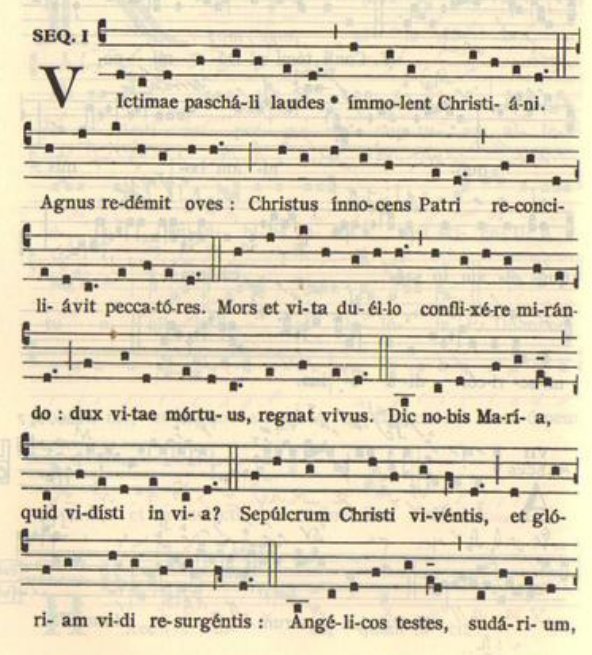
Victimæ paschali laudes illustrates the syllabic style and the strophic form of the sequence. After the abundance of the graduals, it is a return to clarity : one note, one syllable, one word — and the Easter text offering itself almost as a narrative.