What do we mean by « Gregorian » ?
Before reading the neumes, let us go back in time. Where does this chant come from ? Why does it bear the name of a pope ? And why did an alphabet have to be invented in order to write it down ? A short history, without jargon.
1. What exactly is Gregorian chant ?
Gregorian chant is plainchant : a single melodic line, sung in unison (everyone on the same note), with no instrumental accompaniment whatever, and in Latin. No harmony, no orchestra : nothing but voices and a sacred text. This plainness is not poverty ; it is a choice, turned wholly towards prayer and towards making the words intelligible.
Plainchant (from the Latin cantus planus, « even chant ») is the monodic liturgical chant of the Latin Church. « Gregorian » is the name of its most widespread form, the one that established itself in the Carolingian period.
2. A misleading name : Pope Gregory
Gregory I, known as « the Great », was pope from 590 to 604. He is one of the great figures of late antiquity : a tireless reformer, the organiser of the Church of Rome, a considerable spiritual author (we owe him the Pastoral Rule and the Dialogues). Tradition also credits him with reorganising the Roman liturgy and its schola cantorum, the pope's school of singers. From there to making him the author of all the chant that bears his name was but one step… which the Middle Ages cheerfully took.
The legend of the dove
Around 873, nearly three centuries after his death, a Life of Gregory tells a scene that was to make its fortune : the pope receives the melodies directly from the Holy Spirit, in the shape of a dove perched by his ear, while he dictates them to a secretary. Medieval iconography seized on the story and repeated it endlessly : Gregory writing, the dove on his shoulder, and often a scribe spying on him from behind a curtain, astounded to see him break off… and then resume, inspired.
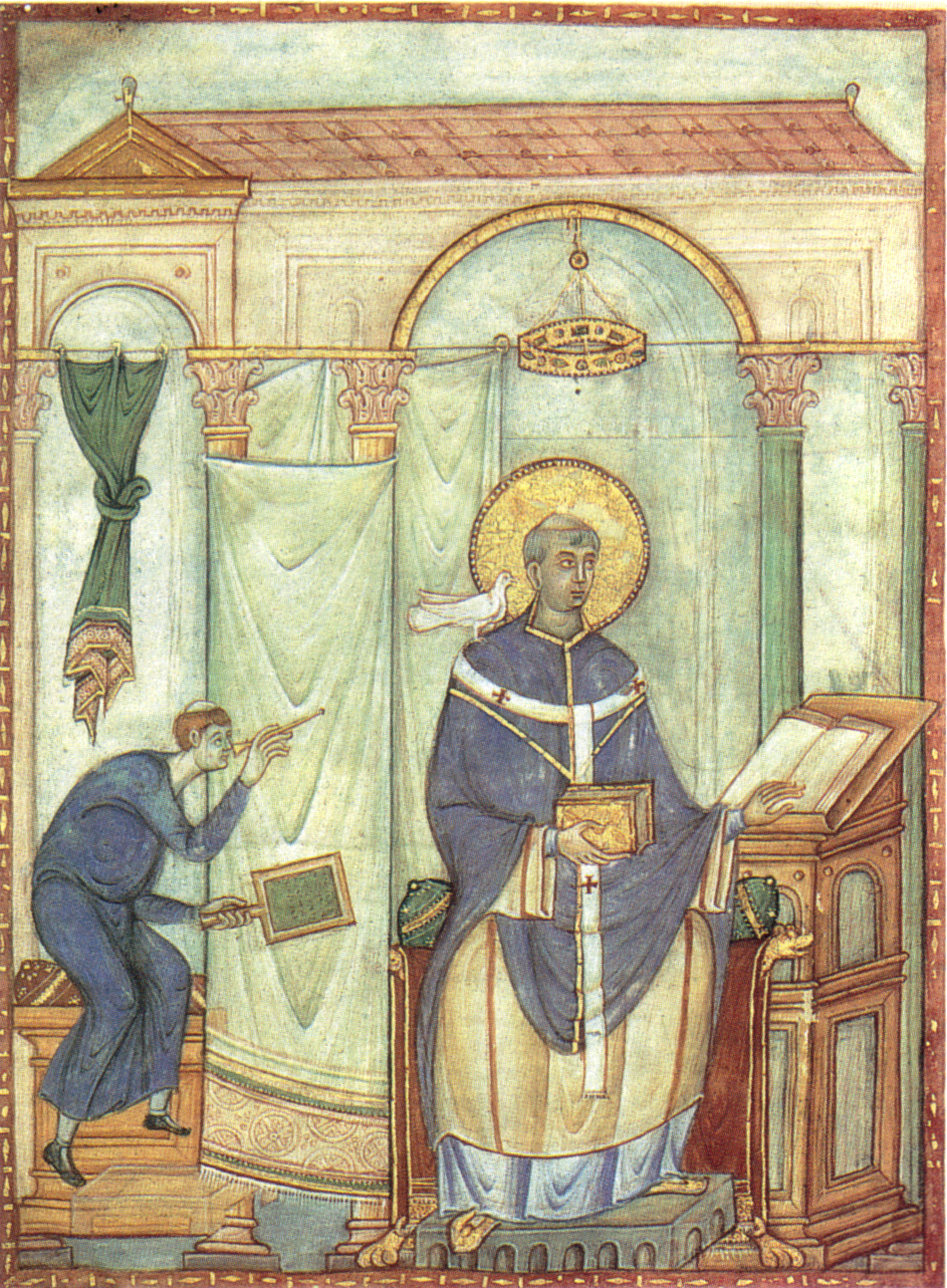
What history says
It is a fine legend — but a legend. Gregory died in 604 ; yet the repertory as we know it only took shape in the 8th–9th centuries, from the meeting of Roman chant with Frankish usage (we speak of a « Romano-Frankish » synthesis). Gregory may well have set liturgical reforms in motion ; he did not « compose » these melodies, and he never saw a neume — they would appear only two and a half centuries after him.
Why the name stuck
So why « Gregorian » ? Because the attribution was useful. When the Carolingians set out to impose Roman chant on the whole of Europe (see below), there was nothing like placing it under the patronage of a prestigious pope : that gave it the authority of Rome and the prestige of sanctity. The « Gregory » label served as a seal of authenticity. The name has stuck ; the reality is more collective, later — and, let us say it, more interesting.
Gregory the Great is the symbolic patron of Gregorian chant, not its author. Remembering that is to understand that Gregorian chant is a collective work, shaped by generations of singers, and not the miraculous dictation of one man.
3. Before Charlemagne : eastern roots
Christian chant did not come out of nowhere. The very first Christians were, for the most part, Jews familiar with the chant of the synagogue (Hebrew cantillation) : for them, singing the word of God went without saying. Around the Mediterranean they were also steeped in other traditions — Byzantine, and later Arab-Muslim (Quranic cantillation) — all of which share the same reflex : the sacred word is sung, it is not simply read.
Musical examples
Three pieces of listening are enough to hear the family likeness : a cantillation of the Torah (with its te'amim), a Byzantine hymn and a call to prayer (adhan), then a Gregorian psalmody for comparison.
The legacy of the synagogue : psalmody
At the heart of Gregorian chant are the psalms — those 150 poems inherited from the Hebrew Bible, sung for more than two thousand years. Christians inherited from them the practice of psalmody (singing a psalm to a simple melodic formula), but also its two great ways of doing so :
- responsorial : a soloist sings the verses and the assembly answers with a refrain ;
- antiphonal : two choirs answer one another in alternation — a practice the West (St Ambrose in Milan) did indeed import from the East.
More striking still : some Hebrew words passed unchanged into the mouths of Latin singers. When you hear Alleluia (from the Hebrew Hallelou-Yah, « praise the Lord »), Amen, Hosanna or Sabaoth, you are hearing a direct thread linking the synagogue to the choir of the monks.
Byzantium and the Christian East
The other great neighbour is the Byzantine world (the Greek-speaking Christian East). To it we probably owe one of the most structuring features of Gregorian chant : the organisation of the melodies into eight modes. The Byzantines had their system of eight « tones » (the oktoechos) ; the Carolingian theorists set up, in parallel, the eight modes of the West. A direct borrowing is hard to prove — but the kinship of spirit is plain.
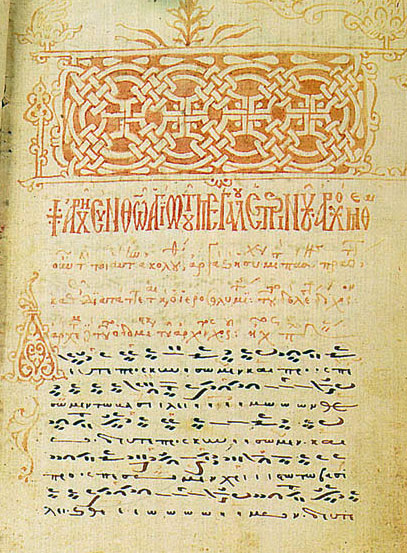
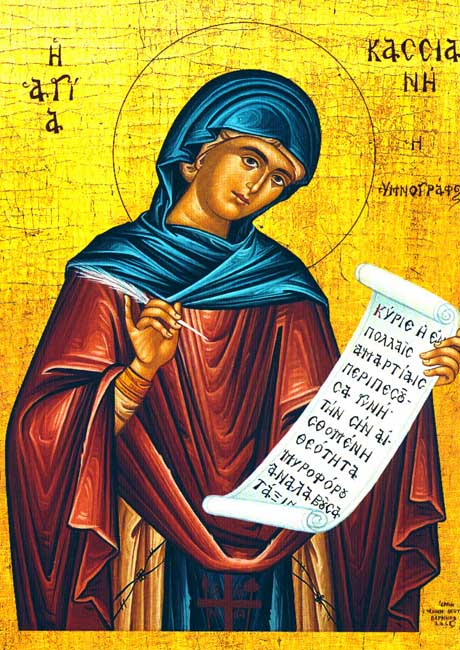
From the East too comes a certain taste for ornament : those long vocalises on a single syllable (the melisma, see the gradual Viderunt omnes) call to mind the fervour of eastern chants. It is no accident that ensembles such as Organum (Marcel Pérès) embrace, in their performances, this colouring from the East.
One and the same gesture : the sacred word sung
As you can tell : three different worlds, one and the same fundamental gesture — carrying a sacred text on a melody, to engrave it in the memory and lift it above ordinary speech. Gregorian chant is one branch of that great Mediterranean tree.
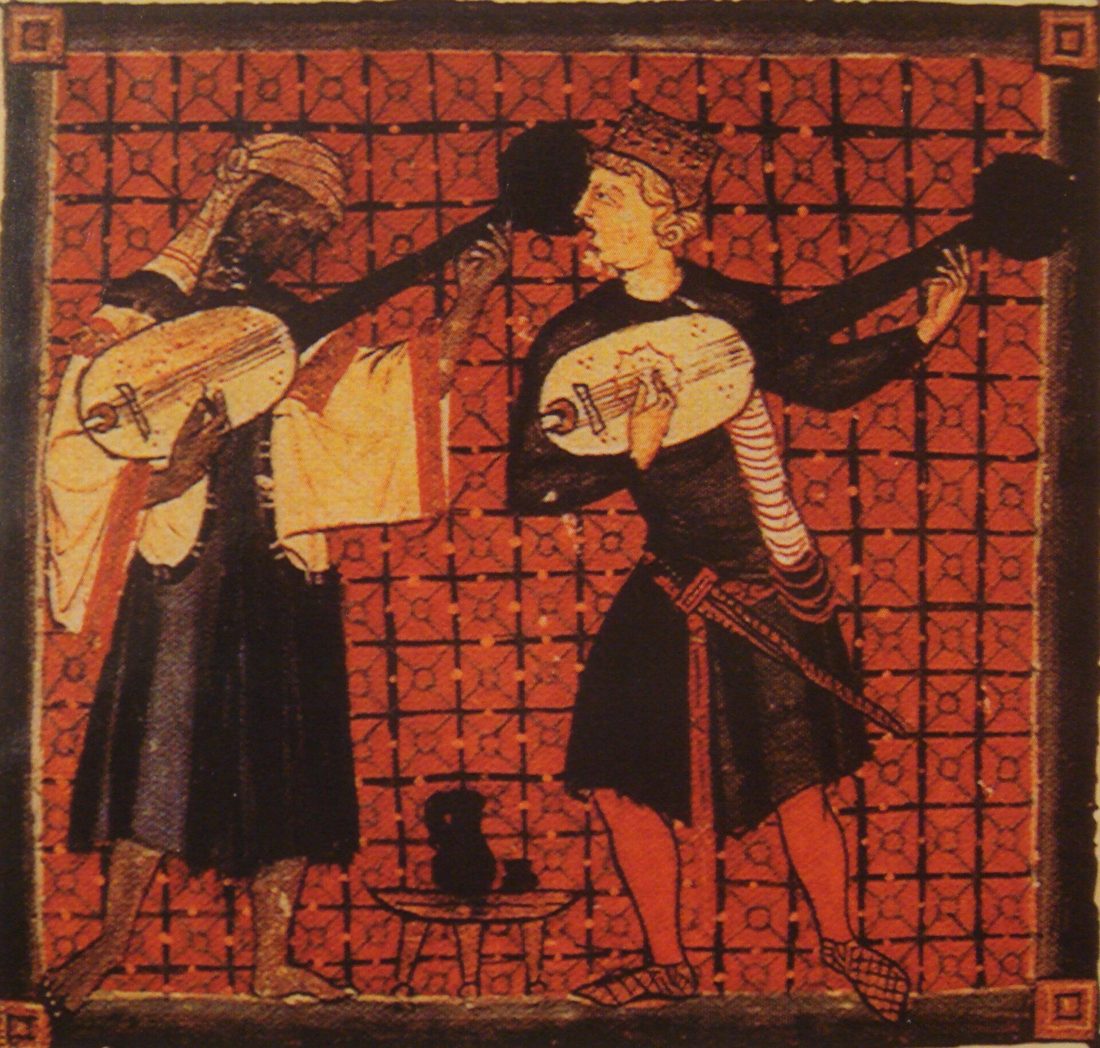
Talking about « influences » calls for modesty : since everything was handed down orally, we have no recording of these ancient chants. We reason by kinship and by clues (words, structures, written testimony), not by evidence of sound. So keep « family likeness » rather than « copy ». Let us not forget the presence of the Arabs on the Iberian peninsula (al-Andalus) for 7 centuries (711-1492), and the many commercial, political, religious and cultural exchanges that took place between Christians, Jews and Muslims during this period.
Yes, and it is fascinating ! Several traditions independently invented signs « above the text » very close, in spirit, to our neumes :
- the Hebrew te'amim (cantillation accents of the Torah) : little signs placed around the words to guide the melody — exactly the same idea of a gestural aide-mémoire ;
- Byzantine notation (« palaeo-Byzantine » neumes), likewise at first indicating the gesture, before becoming more precise ;
- the Arab-Muslim tradition, long essentially oral (handed down from master to disciple).
In other words : everywhere, people first memorised, then wrote down reminders — never, at the outset, a complete score.
4. The Carolingian unification
By the 8th century the Christian liturgy was everywhere in Europe… but in very different forms from one region to another : « Old Roman » chant, Gallican in Gaul, Ambrosian in Milan, Mozarabic in Spain, Beneventan in southern Italy. As everything was handed down orally, each region sang « its own way », and the melodies drifted.
Charlemagne (following his father Pepin) wanted to unify his empire — through chant as well. He imposed « Roman chant » as the standard. From the meeting of that Roman chant with Frankish usage was born the repertory we call Gregorian today. The unification was as political as it was spiritual.
5. 9th century : the invention of neumes (about 850)
One large problem remained : how to make sure that everyone sang the same thing, when nothing was written down ? The answer appeared around 850 : people began adding little signs above the text, the neumes.
Careful, this is the crucial point : these first neumes note neither the exact pitches, nor the intervals, nor a measured rhythm. They indicate only how each syllable is to be sung — rising, falling, pressing, lightening — and certain vocal effects. They are aides-mémoire : they serve to recover a melody one already knows by heart, not to discover it.
A demonstration : « Frère Jacques » in neumes
To get a real feel for this, let us play a game : here is the beginning of Frère Jacques written « in the old manner », with neumes floating above the syllables, with no staff. The dotted line stands for the gesture of the voice.
That is the whole logic of the first neumes : a singer who knows the melody finds his bearings in it instantly ; a beginner is left helpless. What is still missing is the information about precise pitches. That is exactly what square notation was to bring.
This need to pinpoint the pitch of the notes already appears, even before square notation, in older manuscripts from other regions (Aquitaine, for instance).
6. 11th century : square notation
From the 11th century onwards a decisive step was taken : the signs were aligned on a staff, which gradually settled at four lines. From then on, the height of a sign on the staff indicated the pitch of the sound. The notation does not give an absolute pitch (the choir adapts it to its voices), but it notes precisely the intervals between the notes. Here is the same beginning of Frère Jacques, this time « set down » on a staff :
7. Solesmes : the great restoration
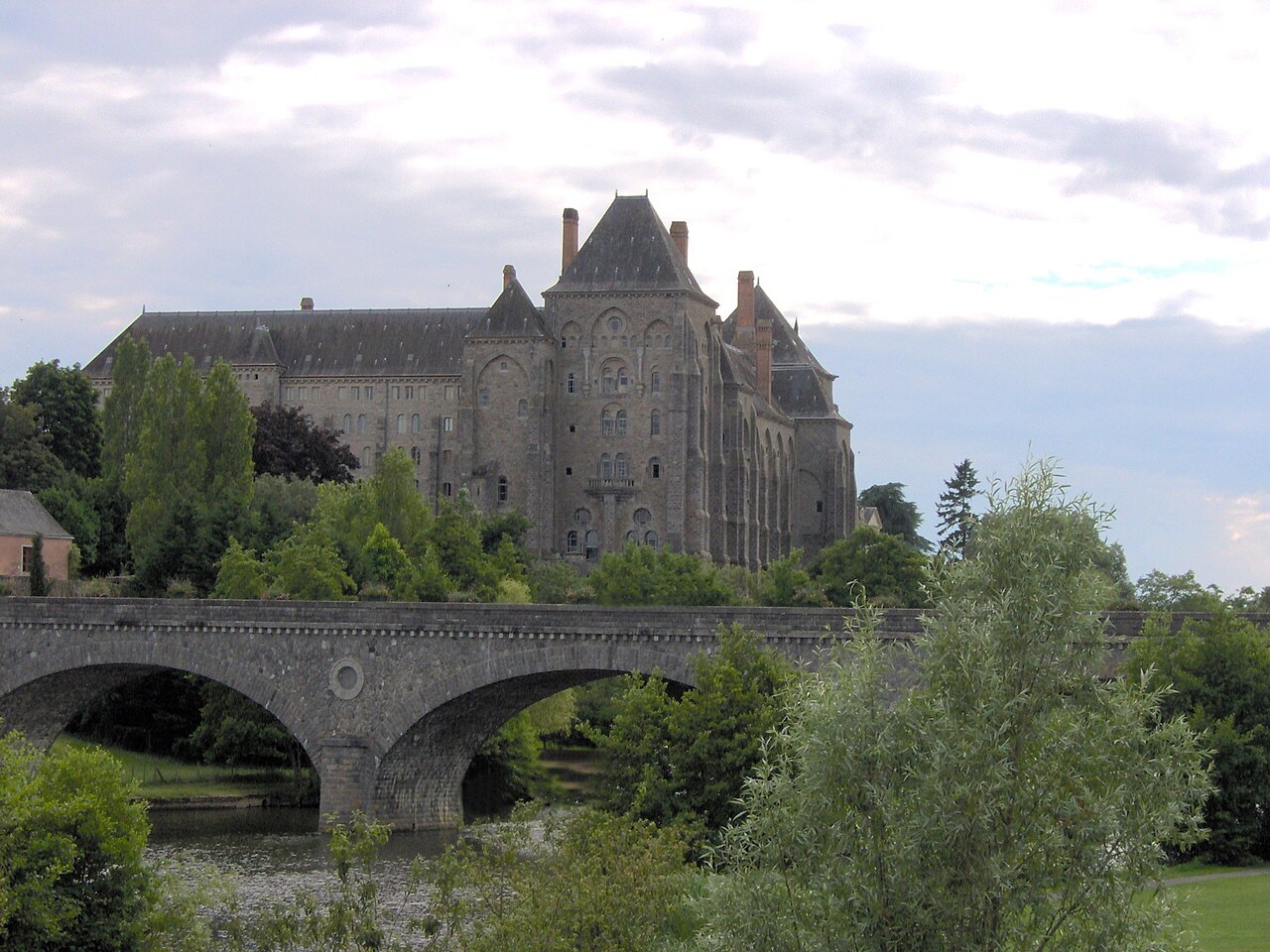
Let us leap forward in time. Over the centuries Gregorian chant had become disfigured : melodies shortened, weighed down, « modernised » editions full of mistakes. In the 19th century a small abbey in the Sarthe was to change everything and give the chant back its authentic face : Solesmes.
Dom Guéranger and the Benedictine revival
In 1833, Dom Prosper Guéranger refounded the abbey of Saint-Pierre de Solesmes and restored there the Benedictine life, almost extinct in France after the Revolution. Passionate about the liturgy, he wanted to be done with the corrupt versions then in use and to go back to the sources : to recover the melodies as the early manuscripts had preserved them. That is the starting point of a scholarly adventure that would last more than a century.
Scholarship at the service of the chant
Two monks were to turn that intuition into a rigorous method :
- Dom Joseph Pothier compares the manuscripts and reconstructs the melodies ; his Mélodies grégoriennes (1880), then his Liber gradualis (1883), mark the return of « true » Gregorian chant.
- Dom André Mocquereau launches in 1889 the Paléographie Musicale : a monumental collection of photographic facsimiles of manuscripts from all over the world. By publishing side by side dozens of witnesses to the same chant, it proved, evidence in hand, what the original version had been. It is the direct ancestor of the approach of the Graduale Triplex.
The Vatican edition and the motu proprio of Pius X (1903)
The work of Solesmes received a resounding endorsement. In 1903, Pope Pius X, in his motu proprio Tra le sollecitudini, proclaimed Gregorian chant the model for all sacred music. Hard on its heels came the Vatican edition — the Kyriale (1905), the Graduale (1908) — prepared with the help of Solesmes : it is the official reference in square notation.
| Date | Event |
|---|---|
| 1833 | Dom Guéranger refounds the abbey of Solesmes. |
| 1880 | Dom Pothier, Les Mélodies grégoriennes. |
| 1889 | Dom Mocquereau launches the Paléographie Musicale. |
| 1903 | Motu proprio Tra le sollecitudini of Pius X. |
| 1908 | Vatican edition of the Graduale Romanum. |
| 1979 | Graduale Triplex (the fruit of semiology). |
8. Today's performing styles
How are these melodies sung nowadays ? There is no single answer, but several schools — and that is precisely what makes listening so absorbing.
The classic « Solesmes method »
To make the chant teachable, Dom Mocquereau devised a system of rhythmic signs (little dots, episemas, « ictus ») added to the square notation. The result is the style most people have in mind : a flowing, even and serene chant, with notes of equal length grouped in twos and threes, of great purity (one thinks too of the chant of the abbey of Silos, in Spain). This was long the way taught everywhere.
From method to semiology
In the 20th century, still at Solesmes, Dom Eugène Cardine pushed the study further : he scrutinised the earliest neumes (St Gall, Laon) to read in them nuances of rhythm and expression that square notation had erased. This is Gregorian semiology — and it is exactly what gave birth to the Graduale Triplex in 1979. In other words, « Solesmes » is not frozen : the house that fixed the even version is also the one that reopened the question of nuance.
Historically informed approaches
Other artists go further still in restoring the old details, with more ornate performances, sometimes tinged with the eastern influences mentioned above. Such is the case of ensembles like Organum (Marcel Pérès) or the Ensemble Anne-Marie Deschamps (Venance Fortunat). Between the serenity of Solesmes and the exuberance of Organum there is no « good » and « bad » chant : there are two ways of bringing the same signs back to life.
Each chant page brings together several performances to compare : Solesmes, Organum, the Ensemble Deschamps… Start with Puer natus est, where the monastic style of Solesmes and the approach of Organum can be heard side by side. The theory then takes on its full meaning.
9. Going further
Want to dig deeper ? Here are a few doors in, from the most accessible to the most scholarly. (Always check the conditions of reuse of images, recordings and scores before publishing them on your site.)
📖 Books and references
- Daniel Saulnier, Le chant grégorien (Solesmes) — a short, limpid introduction, ideal after this blog.
- Eugène Cardine, Gregorian Semiology (Solesmes, 1970) — the founding work on reading the early neumes ; more technical.
- Graduale Triplex (Solesmes, 1979) — the book at the heart of this blog, to be kept in front of you ; and the Graduale Romanum for the square notation alone.
- Willi Apel, Gregorian Chant — a classic survey of the history and the forms.
🖥️ Digitised manuscripts (open access)
- e-codices (virtual library of the manuscripts of Switzerland) : it holds the great witnesses of St Gall — the Cantatorium (ms 359), the antiphonary of Hartker (ms 390/391) — and Einsiedeln 121.
- Gallica (BnF) and the portals of municipal libraries : for many manuscripts, including the Laon tradition.
- GregoBase and the Cantus Database : scores and catalogues of Gregorian chants online, useful for tracking down a particular piece.
🎧 Listening and comparing
The best teacher is still the ear. Listen again to the performers mentioned here — Solesmes, Silos, Organum (Marcel Pérès), Ensemble Anne-Marie Deschamps — straight from our chant pages : Puer natus est, Viderunt omnes, Lux fulgebit, Victimæ paschali laudes and the two Alleluias.
Gregorian chant is a plainchant unified in the Carolingian period, with eastern roots, wrongly attributed to Gregory the Great. It was first written down in neumes (an aide-mémoire for the gesture, 9th c.), then made precise thanks to square notation on a staff (11th c.). Today several schools bring it back to life. You now have the whole context : let us move on to reading the signs themselves.