A short glossary of Gregorian chant
All the key words met throughout the blog, gathered here and explained in one sentence. Keep it at hand as you read.
The styles of chant
| Term | In plain words |
|---|---|
| Syllabic | One note per syllable. The text stays very clear. E.g. : the sequence Victimæ paschali. |
| Neumatic | A few notes (2 to 4) per syllable. E.g. : the introit Puer natus est. |
| Melismatic | Many notes on a single syllable. E.g. : the gradual Viderunt omnes. |
| Melisma | The long garland of notes itself, sung on a vowel. |
| Jubilus | The great melisma of joy, typically on the « a » of Alleluia. |
The basic neumes
| Square notation | Neume | Modern equivalent | Movement of the voice |
|---|---|---|---|
 |
Punctum |  |
One note (small square). |
 |
Virga |  |
One note (square with a stem), often higher. |
 |
Pes (podatus) |  |
Two notes going up. |
 |
Clivis (flexa) |  |
Two notes going down. |
 |
Torculus |  |
Three notes : low · high · low. |
 |
Porrectus |  |
Three notes : high · low · high. |
 |
Scandicus |  |
Three (or more) notes going up. |
 |
Climacus |  |
One note then a descending cascade of diamonds. |
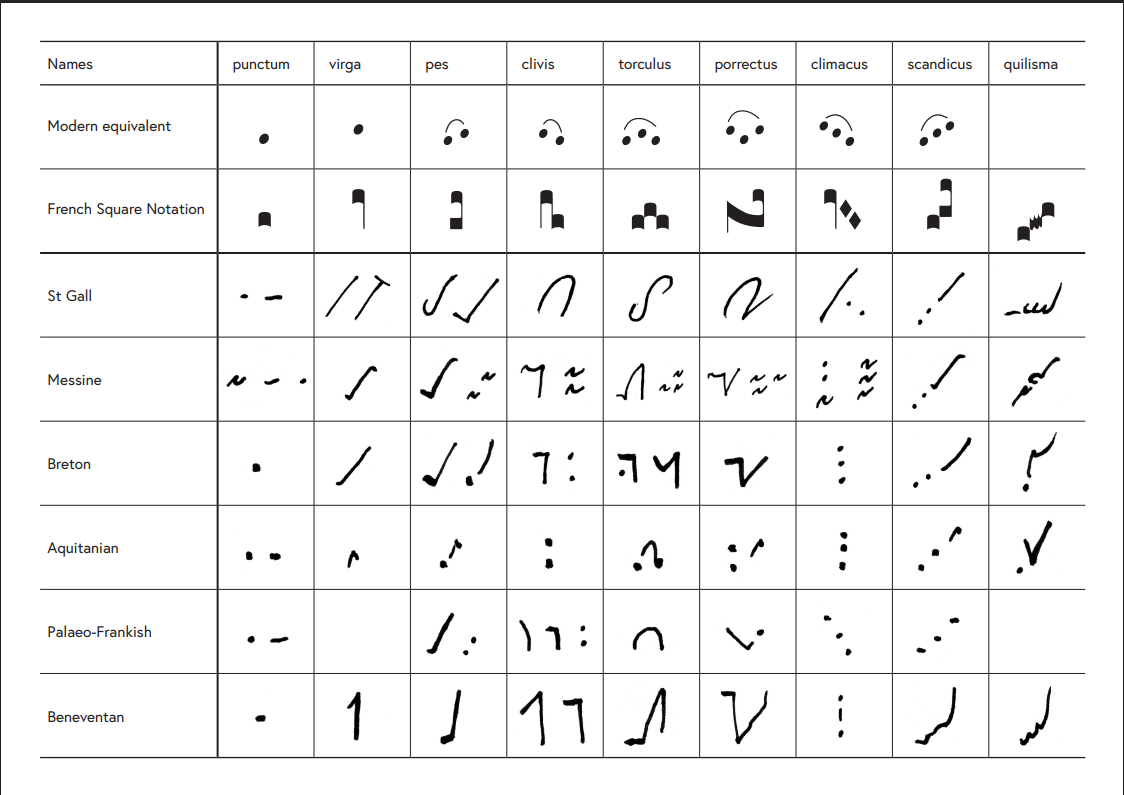
The following table, taken from an online course by the University of Basel, also compares these neumes across several old scripts — St Gall, Messine, Aquitanian…
The signs of nuance
| Sign | What it asks for |
|---|---|
| Quilisma | A light zigzag note, a springboard to the next note ; the preceding note is slightly lengthened. |
| Episema | A small stroke : the note is settled on, broadened. |
| Letter c | celeriter — quickly, without leaning. |
| Letter t | tenete — hold, lengthen. |
| Letter a | altius — higher. |
A few additional definitions
| Term | In plain words |
|---|---|
| Neume | A sign notating one or more sounds on the same syllable (from the Greek pneuma, breath). |
| Staff / tetragram | The four lines on which square notation is written. |
| Clef | A marker at the start of the line (C or F clef) that locates the semitones. |
| Diastematic | Notation that indicates exact pitches (square notation). |
| Adiastematic | Notation « in the open field », showing the gesture without precise pitches (the old neumes). |
| Litteræ significativæ | The small letters added to the neumes to specify rhythm or expression. |
| Mode | The « family of notes » and the colour of a melody (eight modes in chant). |
| Graduale Triplex | Book from Solesmes (1979) superimposing three notations : Laon (top), square notation (centre), St. Gall (bottom). |
| Laon (ms 239) | 9th-c. manuscript ; Messine script, famous for its rhythmic precision. |
| St. Gall | Swiss manuscripts (Cantatorium 359, Einsiedeln 121) ; a clear script for the melodic gesture. |
The genres of chant encountered
| Genre | Role in the Mass |
|---|---|
| Introit | Entrance chant. E.g. : Puer natus est, Lux fulgebit. |
| Gradual | Meditative chant after the 1st reading. E.g. : Viderunt omnes. |
| Sequence | Strophic chant before the Gospel, on great feasts. E.g. : Victimæ paschali laudes. |
| Alleluia | Acclamation before the Gospel, prolonged by the jubilus. E.g. : Dies sanctificatus, Pascha nostrum. |
The best teacher remains the ear : listen to recordings of these six chants (many monasteries share them freely) while following the text, then while following the neumes. Little by little, the drawing and the sound will come together.
Where they fit in the Mass
These chants aren't interchangeable : each has its precise place in the order of the Mass. Two categories are traditionally distinguished :
- the Proper (Proprium) : the text changes according to the feast of the day — this is where our six chants belong ;
- the Ordinary (Ordinarium) : the text stays the same all year round (Kyrie, Gloria, Credo, Sanctus, Agnus Dei…).
Here is the order in which these pieces are sung during Mass :
| Chant | Proper or Ordinary ? |
|---|---|
| Introit | Proper |
| Kyrie | Ordinary |
| Gloria | Ordinary |
| Gradual — followed, on certain feasts, by an Alleluia, a Tract, or a sequence | Proper |
| Credo | Ordinary |
| Offertory | Proper |
| Sanctus | Ordinary |
| Agnus Dei | Ordinary |
| Communion | Proper |
| Ite missa est | fixed text |
Where to find these texts : the Proper is in the Graduale Romanum or the Graduale Triplex (Solesmes ed.), the Ordinary in the Kyriale Romanum (Solesmes ed.).
Chronology up to the First Crusade
The key dates leading from ancient Christianity to the “Gregorian” chant as fixed by the Carolingian era, up to the eve of the First Crusade — the full story is told in What do we mean by « Gregorian » ?
| Date | Event |
|---|---|
| 313 | Edict of Milan : Christianity becomes a lawful religion in the Roman Empire. |
| 4th c. (c. 386) | Ambrose of Milan introduces antiphonal singing in Milan (“Ambrosian” chant). |
| 590 – 604 | Pontificate of Gregory the Great ; reorganisation of the Roman liturgy and its schola cantorum. |
| 711 | Beginning of the Muslim presence on the Iberian Peninsula (al-Andalus). |
| 732 | Charles Martel halts the Saracen advance at Poitiers. |
| 768 – 814 | Reign of Charlemagne : Roman chant is imposed across the empire ; its encounter with Frankish practice gives birth to the “Gregorian” repertoire. The unification of Gregorian chant begins with Chrodegang, bishop of Metz, who founds a Schola Cantorum. |
| 800 | Charlemagne is crowned emperor in Rome by the Pope. |
| 9th c. (c. 850) | The first neumes appear : simple memory aids for the vocal gesture, without precise pitches (the Laon manuscript, Messine neumes). |
| 9th c. | Kassia of Constantinople, Byzantine hymnographer and composer : one of the few medieval women composers whose music has survived. |
| c. 873 | A Life of Gregory tells, for the first time, the legend of the dove of the Holy Spirit. |
| 10th c. | The Einsiedeln manuscript (Stiftsbibliothek, codex 121) : one of the oldest neumed witnesses (St. Gall notation) of Gregorian chant, recording among others the introit Puer natus est. |
| 2nd half of the 10th c. | The first staff lines appear, to make the pitch of notes more precise (in Italy and Aquitaine). |
| 1054 | Schism between the Eastern and Western Churches. The two liturgies (Roman and Byzantine) develop independently from each other from then on. |
| 11th c. | Square notation on a staff appears : pitches finally become clearly readable. |
| 1066 | Norman Conquest of England by William the Conqueror. |
| 1095 | Council of Clermont : Pope Urban II preaches the First Crusade. |
| 1099 | Capture of Jerusalem : end of the First Crusade. |
Bibliography & resources
A selection for going further, from the most accessible to the most specialised.
Introductory works
- Saulnier, Daniel. Le chant grégorien. Solesmes. A short, clear and accessible synthesis : the ideal sequel to this blog.
- Hiley, David. Gregorian Chant. Cambridge University Press, 2009. The standard introduction in English, highly pedagogical.
Specialised works
- Cardine, Eugène. Sémiologie grégorienne. Solesmes, 1970. The founding book on reading the old neumes (St. Gall, Laon) ; technical.
- Apel, Willi. Gregorian Chant. Indiana University Press, 1958. A classic survey of history, genres and forms.
- Solesmes Abbey. Paléographie Musicale (series, from 1889). Annotated manuscript facsimiles ; the origin of the modern restoration.
Chant editions
- Solesmes Abbey. Graduale Triplex. Solesmes, 1979 — and the Offertoriale Triplex (Solesmes, 1985) for the offertories and their verses. The edition at the heart of this blog : square notation + neumes of Laon and St. Gall.
- Solesmes Abbey. Graduale Romanum. (Vatican edition). The official gradual in square notation only.
Digitised manuscripts & online resources (freely accessible)
- e-codices. Virtual manuscript library of Switzerland. Major witnesses from St. Gall : Cantatorium (ms 359), Hartker antiphonary (ms 390/391), and Einsiedeln 121.
- Gallica. Digital library of the BnF. Many liturgical manuscripts, including the Laon tradition.
- GregoBase ; Cantus Database. Databases of scores and Gregorian chants. To find, catalogue and transcribe a particular piece.
The interpretations mentioned in this blog (Solesmes, Silos, Organum / Marcel Pérès, Venance Fortunat / Anne-Marie Deschamps) are gathered, ready to compare, on each chant page — start with Puer natus est.
Your suggestions
A remark, a typo you spotted, an idea for another chant to add ? This blog is meant to keep growing : feel free to write to us.